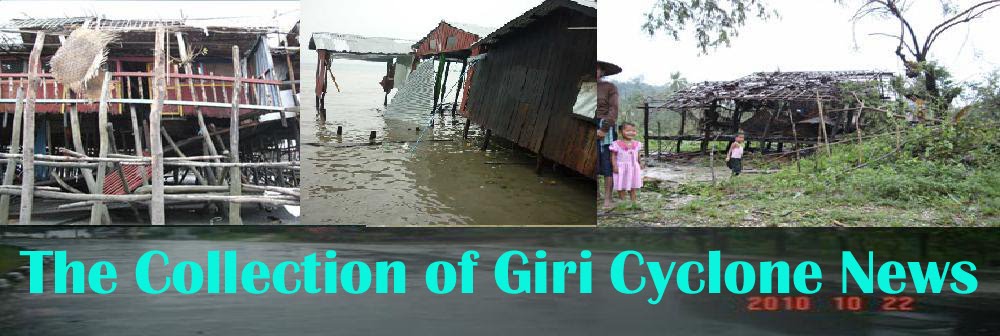
Cyclone Giri Photos
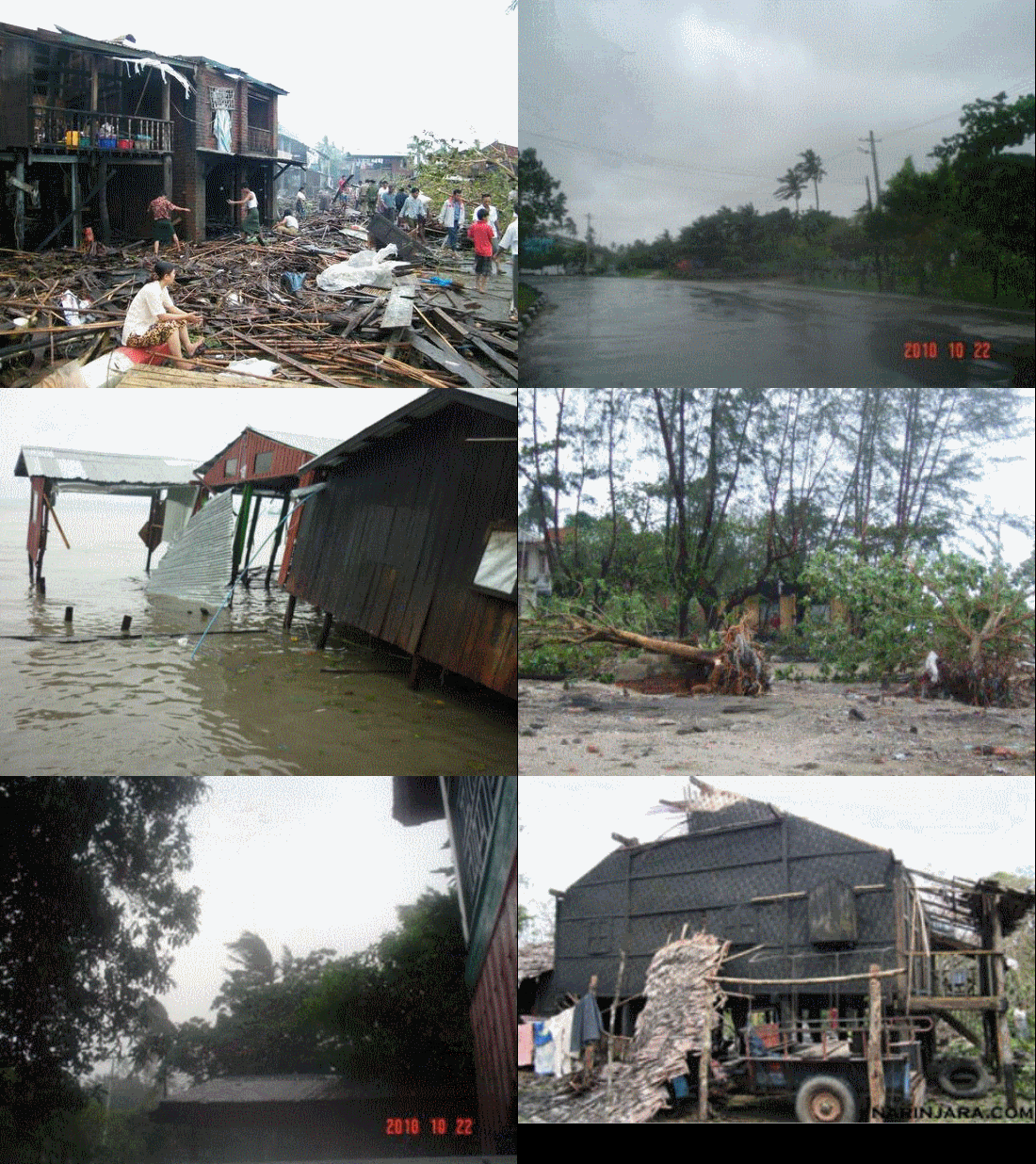
Prayer ceremonies were held at home and abroad to observe the anniversary of Cyclone Giri that slammed into the coast of western Burma's Arakan State on the 22nd of October 2010.

U Aung Marm Oo, the director of the Arakan Human Rights Organization, said a prayer ceremony was held in a Buddhist monastery in Maepa Village in Thailand’s Mae Sot in order to make people more aware if what had happened during Cyclone Giri.
“We hold this ceremony especially to draw attention from the ethnic Burmese community as well as from the international community, and to make them aware of what really happened during that cyclone in Arakan State”, said Aung Marm Oo.
Attendees at the ceremony lit candles and prayed silently for a while according to their various religious faiths, for those who were killed and affected by the cyclone, and then speeches were given.
U Khine Oo Maung, the director of a migrant school on the Thai-Burmese border, said the natural calamity came as a result of damaging the natural environment, in his speech at the ceremony.
“Natural disasters were very rare in our childhood in Arakan State, but they are now quite frequently occurring because the natural environment that was a natural shield to such disasters has been badly damaged due to the greedy exploitation of natural resources by the Burmese military dictators in our region”, said Khine Oo Maung.
U Shwe Nhin, a Karen freedom fighter and headmaster of the migrant school, also spoke in the ceremony and said that he prays every Sunday and would continue his prayers, hoping that all people in Burma will be free from natural disasters and oppressed lives, and for peace and development in the country.
Videos and slideshows of photos from the Giri affected areas were presented in the ceremony in Mae Sot and over 120 people, including representatives of the Arakanese and other ethnic organizations, individuals and migrant workers attended in the ceremony.

Cyclone Giri hit hardest on the townships of Kyaukpru, Mraybon, Pauktaw and Ann in Arakan State on 22 October 2011, leaving nearly 100 people killed, 70,975 peoples homeless and over 2, 60,000 affected.
Narinjara News
Nava Thakuria
-----------------
Even as the military rulers of Burma (Myanmar) completed a general election in November 2010 and a new so-called democratic regime is installed in the poverty stricken country, millions of Burmese are still living in terrible conditions in the cyclones Nargis and Giri affected areas, with many without pure drinking water and food or proper shelter.

Burma receives international media headlines with the flawed constitution and electoral laws that finally prevented the pro-democracy icon Suu Kyi to take part in the November 2010 polls. Her party National League for Democracy, which recorded massive victory in the last general election in 1990- but denied power by the junta- even faced forced dissolution as it did not register with the election commission as a mark of protest. The recent visit of Burmese President Thein Sein to India on October 12 -15, 2011 was an attempt to improve its tie with the largest democracy of the globe and also enhance the Southeast Asian country’s image as a welfare nation. But the ground reality remains almost the same.
Since the day when the devastating tropical cyclone Nargis struck Burma (Myanmar) on May 2, 2008, the women survivors remain worst sufferers. Despite the fact that three full years passed since fateful night, the relief from international agencies, originally blocked by the then military regime, remains sporadic, paltry and tragically late, those all compiled to the continued agony for the poor Burmese people primarily women and children. The cyclone, originating in the Bay of Bengal, ripped a trail of destruction across the Irrawaddy and Rangoon divisions and also ravaged parts of the Bago, Mon and Kayin regions. A water wall of four meters high is said to have rolled some 25 miles inland across the Irrawaddy River Valley, flattening everything in its path. Although the military government reported the final death toll as 84,537, with 53,836 missing, independent estimates are that 140,000 were killed and tens of thousands more have never been found. The cyclone devastated the already spavined social infrastructure, and wiped out paddy fields, which at the time were being readied for the country's primary rice crop. Even one of latest reports of Human Rights Watch, New York reveals that the Burmese government continues to deny basic freedoms and place undue restrictions on aid agencies despite significant gains in rehabilitating areas devastated by the cyclone Nargis. Mentionable is that the then Burmese group of generals named State Peace and Development Council initially did not allow international aids to its own people initially and thus they received condemnation and brickbats from the international community for their callous and cruel attitude.
“For nearly five decades, Burma's military rulers had systematically undermined the interests of their own citizens. It wasn't until days into the tragedy, goaded by international criticism, that the SPDC chief senior general Than Shwe found the time to visit the destroyed areas,” said in the report.
The then military chief Than Shwe and his company later softened following a personal visit of the UN Secretary General Ban Ki-moon in the middle of May 2008. Slowly communications between the local government and the international agencies began to improve. Visas and travel permits were made a little easier and faster for the foreign aid workers.
The officials of Human Rights Watch however claim that the local aid workers still feel the brunt of continued repression by the military authorities. The report quoted many woman survivors of Cyclone Nargis to narrate the tale of awfulness. One May Khin, a middle aged woman from Laputta township described her pain, “Nargis was the worst experience of my life. The last thing I remember is the lightning coming together with a strong wind and later a giant wave covered my daughter and me while we were running to the monastery. Then we were separated. I was washed away by the wave and became unconscious. When I came around, there were no clothes on my body and I could not walk as I had no strength. Beside me there was a dead body.” The International Organization for Migration claimed that nearly 400,000 people in Burma were still living without a proper home after a devastating cyclone. It also disclosed that the government while failed to provide adequate food, water and shelter to the survivors, shamefully continues violating the rights of the victims as well as the local relief workers.
Quoting the officials and aid workers, The Myanmar Times, a semi-government weekly newspaper published from Rangoon, reported that even after ‘three years after Cyclone Nargis thousands remain in need of shelter assistance’.
“This is an area where there are still huge needs,” said Arne Jan Flolo, first secretary of the Norwegian embassy in Bangkok. Even the UN Human Settlements Program estimated that some 375,000 people still need housing, 36 months after the worst natural disaster that stroke Burma.
If Nargis was of higher intensity, the Cyclone Giri struck the Arakan coast with comparatively lower magnitude. The category 4 cyclone hit the western coast of Burma on October 22, 2011 affecting the whole province. Over 100 people were killed and nearly one million Burmese were affected by the cyclone. According to the UN, over 70,000 people were left homeless by the disaster.
Quoting the Arakan League for Democracy, the Narinjara news, a pro-democracy portal, reported that villages like Kyuntharyar, Pyintharhtwatwa, Taungpaw, Angu, Ywathikay, Taungnyo, Kangyemaw, Dagon, Kanthar were severely affected where the people are still running out of safe drinking water.
“There is a shortage of drinking water. In the contaminated wells and ponds, saltwater sinks and the freshwater stays atop. So people collect and use the water sitting at the top portion of the well. But it is not that safe to drink. Some people still use water contaminated with saltwater. Some use the water from the well that is full with garbage,” the ALD source claimed.
Responding to this writer’s queries, a Rangoon based UN official argues that Nargis was a tragedy that every one has learnt bitter lessons from. So the large scale deaths could have avoided in the time of Giri with more awareness and early warning efforts. Putting his individual view, Aye Win, an official of United Nations Information Centre at Rangoon said, “The earthquake in Tachilek, tragic though it was, brought a greater closeness of cooperation between the humanitarian community and the authorities. The importance of disaster risk reduction was recently underscored by the visit of the Special Representative of the Secretary General on DRR, Margareta Wahlstrom, to Myanmar in early October. There is now greater awareness, and more importantly, greater political willingness to approach DRR holistically because of its long term impact.” Talking to this writer from New Delhi, Thin Thin Win, an exile Burmese lady claimed that the regime had done very little for the rehabilitation for the cyclone victims and they turned out to be inhuman for the women and children. Form the ground reality, it is understood that it would take few more years to completely rehabilitate the affected people in the cyclone affected areas of Burma, she asserted.
The hapless situation has compelled the poor Burmese, mostly young girl and women to fall in trap of traffickers, the fact admitted by the UN official. The US Campaign for Burma stated in a report that the underdeveloped country emerges as a source place for women, and children who subjected to sex trafficking in other countries. Burmese children are forced to labor as hawkers and beggars in Thailand. Many Burmese men, women, and children who migrate for work in Thailand, Malaysia, China, Bangladesh, India, and South Korea are subjected to conditions of forced labor or sex trafficking in these countries. The Rangoon UN official agrees that trafficking in Burma is an important issue to deal with. It will continue to be as long as the grass is continued to be perceived as greener on the other side. The driving force therefore is poverty. The issue of poverty is now publicly and openly acknowledged, a first step on a journey of perhaps a thousand miles, to quote Confucius, Aye Win concluded. The US Campaign for Burma also added in the report, “Military and civilian officials subject men, women, and children to forced labor, and men and boys as young as 11 years old are forcibly recruited to serve in the Burma army as well as the armed wings of ethnic minority groups through intimidation, coercion, threats, and violence. Some observers estimate that thousands of children are forced to serve in Burma’s national army as desertions of men in the army continue.”
The cyclone killed 45 people, with estimates of at least 260,000 Burmese severely affected. There has been widespread damage to houses, crops, schools, roads and bridges.
Foreign Minister Kevin Rudd said that Australia will provide $3 million in assistance to help affected communities and families recover from this disaster and provide essential food, shelter, clean water and sanitation.
An immediate $200,000 was provided last month through the Australian Red Cross, and the further $2.8 million announced today will be delivered through the United Nations World Food Programme and Australian non-government organisations, CARE Australia, Save the Children Fund, Oxfam Australia, Burnet Institute and the Australian Red Cross.
"Australia's funding will help those left homeless and in need of food and emergency supplies," said Mr Rudd.
http://www.foreignminister.gov.au/releases/2010/kr_mr_101120.html
Mray Bon: A teacher who was selected to serve as a polling booth officer was dismissed from his job by high authorities after he traveled to his native village to attend his father's funeral during the election period, said close friend of his.
He said, "His father died during Cyclone Giri. He went to his native village to attend his father's funeral without permission from the authorities in the education department. Because of this, the authority fired him from his job."
The teacher who was fired is U Ba Hlaing, who was serving as a teacher at a primary school in Phone Nyo Late Village in Buthidaung Township. His father, U Hla Maung Tha, died tragically in Htoo Chay Village in Mray Bon Township when the cyclone struck the Arakan coast on 22 October.
"He requested permission from the authority in the education department in Buthidaung Township to attend his father's funeral, but the authority refused permission because he was a polling booth officer assigned to supervise the polling booths on election day. He went to his village to attend his father's funeral against the authority's prohibition. Later he was fired from his job by the high authority," he said.
According to the source, the education department of Buthidaung sent a letter to him explaining that he was fired from his job for failing to follow the authority's instructions.
The Burmese military junta will hold the first election in two decades on 7 November, 2010, amid international criticism that the polls will not be fair or free. Many government servicemen have been appointed as polling booth officers.
http://www.narinjara.com/details.asp?id=2792

Relief organizations responding to Cyclone Giri, which pounded western Myanmar on Friday, are finding homes and schools swept away and a need for emergency food and water in the saltwater soaked islands.
"The winds that hit these islands were over 200 km an hour and in many of these places there was a tidal surge of about 10 feet," said Andrew Kirkwood, Save the Children's country director in Myanmar. "Fishing boats have been sunk and paddy fields have been inundated with sea water. Houses have either been blown or washed away. Over 300 schools have been destroyed. It's left a huge wave of destruction behind."
The official death toll in the hardest hit townships of Kyaukpyu, Myebon and Pauktaw was 45, though 200,000 are in need of emergency food supplies, such as rice and beans, and probably will be for the next three to six months, he said.
By comparison, the country's last major cyclone, Nargis, which struck the Irrawaddy Delta in May 2008, killed an estimated 130,000 people.
 Children take shelter in a monastery.
There were major differences between the two cyclones, including an early-warning system for Giri. Radio and television announcements -- and in some cases people walking around with megaphones -- alerted residents to the approaching storm.
In addition, while the intensity of both storms was similar, the delta where Cyclone Nargis hit is very flat, whereas Giri's path was over hilly terrain, giving people a chance to get to higher ground, Kirkwood said.
Another difference was in the response of Myanmar's government, which was criticized in 2008 for being too slow to let international aid workers into the country.
Kirkwood said the government was much better prepared this time, and his staff received good help from local authorities. They also didn't need to fly in international staff or relief shipments as they after Nargis, because the number of people affected is smaller and they can buy relief supplies locally, he said.
After Nargis, people in Myanmar have a much greater awareness of safer building techniques, Kirkwood continued. "There are very simple things that people can do to strengthen public buildings and homes to make them more cyclone-resistant, including improved bracing and foundations."
However, there's still very little one can do against a Category 4 cyclone and the accompanying tidal surge, he added. People will need to rebuild their livelihoods, including replacing fishing boats and farming tool.
 Destroyed cyclone shelter. All photos courtesy of Save the Children
In one community the Save the Children team visited, a cyclone shelter built in 1962 had its roof ripped off by Giri. "We interviewed one man, 84 years old, who said this is the fifth major cyclone that he can remember but this is much stronger than anything that he has seen in his lifetime," Kirkwood said.
See more international stories on our World View page and follow us on Twitter.
Sittwe: Over 100 people were killed and thousands left homeless when Cyclone Giri struck Arakan State in Burma on Friday evening, and the Arakanese political party Rakhine National Development Party, or RNDP, has appealed to the international community for assistance.
The RNDP issued a statement relating to Cyclone Giri with emergency declaration No. 1/2010, wherein the party appealed to the international community to provide humanitarian aid to cyclone victims.
Cyclone Giri hit two districts - Sittwe and Kyauk Pru - in Arakan State on Friday, 22 October, triggering tidal surges and flooding that left nearly 100,000 people homeless. The victims are now taking refuge in temporary shelters.
The death toll in the two districts rose to at least 100 following recovery of bodies throughout the week up to Thursday, but Burmese authorities announced that only 27 people were killed in the cyclone.
The worst affected area was Mray Bon, Kyauk Pru, Min Bya, Pauktaw, and Man Aung, where the UN reported 70,000 people have been left homeless and 130,000 have been severely affected by the disaster.
The RNDP stated that hundreds of rural houses have been destroyed or damaged, families have lost their essential household items, and crops have been destroyed. The displaced population has taken shelter in temporary huts without proper roofs or water wells.
Dr. Aye Maung, President of the RNDP, said, "We request on behalf of the Arakanese community to the UN and international community to provide aid to the victims of the deadly cyclone immediately. The victims are now facing many challenges struggling for their survival. The victims need emergency aid from the international community."
Cyclone Giri is the worst cyclonic storm to hit Burma since Cyclone Nargis claimed more than 100,000 lives in the Irrawaddy Delta in May, 2008, but there is yet to be much relief aid for the victims.
Dr. Aye Maung also said that storms often hit the coastal areas of Arakan every year, especially in the rainy season. Because of this, he has also requested that the concerned government authorities, the UN, and international NGOs consider a long-term plan to mitigate the impact such storms have on residents.
Speaking to Narinjara over the phone, Dr. Aye Maung said that cyclone centers are needed in the lower coastal areas of Arakan State for local residents to seek shelter in whenever cyclones hit the region.
Arakan has consistently faced severe storms every year, but there are no cyclone shelters anywhere in the state.
The RNDP is a political party based in Arakan State that is running 47 candidates in the upcoming election scheduled to be held on 7 November, 2010.
http://www.narinjara.com/details.asp?id=2784
Mray Bon: A cyclone victim hanged himself last week in the town of Mray Bon, the town hardest hit by the cyclone in Arakan, during a fit of depression, said townspeople.
The victim was identified as U Aung Kyaw Sein from Alay Pai Ward in central Mray Bon Town.
An elder from Mray Bon said, "He committed suicide by hanging himself in the compound of his house during a fit of depression. He lost much property, including his home, when the cyclone struck the town. He seemed to commit suicide after losing so much."
He was reportedly faced with many challenges to his and his family's survival after the cyclone, so he chose the path to death, another elder said.
Another middle-aged elder from Sin Daung Village in Mray Bon Township also committed suicide by hanging himself after losing much of his property in the cyclone.
A monk from Mray Bon told Narinjara over the phone that some people in Mray Bon Township have been committing suicide by hanging, while others are dying from cholera and diarrhea contracted in the aftermath of the storm.
http://www.narinjara.com/details.asp?id=2791
Pauk Taw: Narinjara received the following list of the devastation and 11 deaths caused by Cyclone Giri from a local social relief group:
(Ngari Pike Chai Village)

(Prun Gree Village)
In Prun Gree Village on Aungarar Char Island, 93 out of 96 houses were destroyed, while 28 motor boats, 7 row boats, and 37 fishing nets were washed away to sea. 42 cows and 3 buffalo were killed, but there were no human casualties in the village.
(Ngari Chai Village)

(Kha Maung Kway and Kaing Prun Villages)
All 155 houses were destroyed. 24 motorized fishing boats, 21 row boats, and 47 fishing nets were washed away to sea. The three main water sources were also destroyed by the flood of sea water in Kha Maung Kway and Kaing Prun Villages. No human casualties were reported, but 37 cows and 5 buffalo were killed.
(Thapru Chai Village)
All 65 houses were completely destroyed. 11 motorized fishing boats, 53 row boats, and 32 fishing nets were washed away to sea. One drinking and washing water source was also destroyed by the tidal surge in Thapru Chai Village.
(Ngamae Prun Village)

(Manyun Kaing and Prunphru Chai Village)
All 110 houses were destroyed. 10 motorized fishing boats, 10 row boats, and 14 fishing nets were washed away to sea. One source of drinking and washing water was destroyed by the tidal surge in Manyun Kaing and Prun Phru Chai Villages.
(Kaum Chai Village)
All 61 houses were completely destroyed. 6 motorized fishing boats, 6 row boats, and 8 throw-fishing nets were washed away to sea. One source of drinking water was also destroyed by the sea water in Kaum Chai Village.
(Byaing Thaik Village Group)
One person was killed in Kyauk Maung Village under Byain Thaik Village Group.
Other damages left in the aftermath of Cyclone Giri are still being catalogued by the local social relief groups. Cyclone victims in Pauktaw Township are badly in need of emergency relief and medical care, as there is no organization, either government or non-governmental, that is providing substantial relief aid or medicine.
According to the latest reports received by Narinjara from aid groups working on the ground, the death toll has risen to 157 - with 138 from Mray Bon Township, 5 from Minbya Township according to official data, 11 from Pauktaw Township, and 3 from Kyaukpru Township.
http://www.narinjara.com/details.asp?id=2786
Pauk Taw: Narinjara received the following list of the devastation and 11 deaths caused by Cyclone Giri from a local social relief group:
(Ngari Pike Chai Village)
(Prun Gree Village)
In Prun Gree Village on Aungarar Char Island, 93 out of 96 houses were destroyed, while 28 motor boats, 7 row boats, and 37 fishing nets were washed away to sea. 42 cows and 3 buffalo were killed, but there were no human casualties in the village.
(Ngari Chai Village)
(Kha Maung Kway and Kaing Prun Villages)
All 155 houses were destroyed. 24 motorized fishing boats, 21 row boats, and 47 fishing nets were washed away to sea. The three main water sources were also destroyed by the flood of sea water in Kha Maung Kway and Kaing Prun Villages. No human casualties were reported, but 37 cows and 5 buffalo were killed.
(Thapru Chai Village)
All 65 houses were completely destroyed. 11 motorized fishing boats, 53 row boats, and 32 fishing nets were washed away to sea. One drinking and washing water source was also destroyed by the tidal surge in Thapru Chai Village.
(Ngamae Prun Village)
(Manyun Kaing and Prunphru Chai Village)
All 110 houses were destroyed. 10 motorized fishing boats, 10 row boats, and 14 fishing nets were washed away to sea. One source of drinking and washing water was destroyed by the tidal surge in Manyun Kaing and Prun Phru Chai Villages.
(Kaum Chai Village)
All 61 houses were completely destroyed. 6 motorized fishing boats, 6 row boats, and 8 throw-fishing nets were washed away to sea. One source of drinking water was also destroyed by the sea water in Kaum Chai Village.
(Byaing Thaik Village Group)
One person was killed in Kyauk Maung Village under Byain Thaik Village Group.
Other damages left in the aftermath of Cyclone Giri are still being catalogued by the local social relief groups. Cyclone victims in Pauktaw Township are badly in need of emergency relief and medical care, as there is no organization, either government or non-governmental, that is providing substantial relief aid or medicine.
According to the latest reports received by Narinjara from aid groups working on the ground, the death toll has risen to 157 - with 138 from Mray Bon Township, 5 from Minbya Township according to official data, 11 from Pauktaw Township, and 3 from Kyaukpru Township.
http://www.narinjara.com/details.asp?id=2786

“Neutral humanitarian assistance is more accepted now than in [Cyclone] Nargis times, so we will see in the coming days,” said Bernd Schell, head of delegation for the International Federation of Red Cross and Red Crescent Societies (IFRC) in Myanmar.
Cyclone Nargis, which hit in May 2008, became the largest natural disaster the country had experienced.
International relief agencies in Yangon, the capital of Myanmar, have begun sending national staff members to the coastal western state of Rakhine to join colleagues already in the field measuring damage inflicted by the category-4 storm (category 5 is the worst).
“We have sent out two teams this morning [from Yangon] and have one more going out this afternoon,” said Schell. IFRC’s international staff is on “stand-by” in the capital, ready to join national staff carrying out assessments in the field and awaiting permission to deploy, he added. “We have requested access and are ready go.”
Thus far, international NGOs have only sent national staff to cyclone-hit areas to join national NGOs already working in affected villages.
Schell said local capacity to respond to disasters had improved in recent years, alleviating some pressure on international staff to go into the field.
“A lot of support had been given to the areas that were hit this time, which helped to minimize damage,” he said. Teams of 30-50 Red Cross national volunteers have already begun damage assessments in eight townships in Rakhine State. Some of the hardest-hit communities have been trained in disaster preparedness.
There has been “major learning” since Nargis, UN Resident Coordinator Bishow Parajuli said. “This is evidenced by the advance deployments, evacuations [from high-risk areas]. Details are still emerging.”
Early estimates show two-digit deaths and injuries and up to 10,000 homes damaged, he added.
“International and national UN staff are on stand-by for deployment, depending on the level of devastation and expertise needed,” said Parajuli.
A preliminary Red Cross assessment in one of the townships hit, Kyaupyu, on 24 October, showed at least 4,500 affected people. Information from ongoing village visits has shown still-unquantified housing and agricultural damage, added IFRC’s Schell.
The UN Office for the Coordination of Humanitarian Affairs is compiling information from relief agencies for an updated report on the cyclone’s aftermath for publication on 26 October.
pt/mw
Theme (s): Natural Disasters,
[This report does not necessarily reflect the views of the United Nations]
BANGKOK, 1 November 2010 (IRIN) - Aid workers are worried about possible water contamination after Cyclone Giri swamped the western coast of Myanmar on 22 October, affecting an estimated 200,000 people.
"Ponds may be contaminated by salinated water - but this needs to be confirmed," Thierry Delbreuve, head of the UN Office for the Coordination of Humanitarian Affairs (OCHA) in Myanmar, who visited the affected area, told IRIN on 1 November from Yangon.
Throughout much of rural Myanmar, communal ponds are a main source of fresh water, but after a heavy weather system such as Giri there is a chance flooding and debris could render the water undrinkable.
However, according to Terence Kadoe, a water, sanitation and hygiene (WASH) officer for the UN Children's Fund (UNICEF) in Myanmar, most of the ponds along Giri's trail are in high land areas compared with the low-lying ponds contaminated by Cyclone Nargis which devastated Myanmar's Ayerwady Delta in 2008, leaving more than 140,000 dead and affecting two million.
According to the most recent OCHA situation report, water and sanitation needs arising from the destruction of water sources are among the most urgent, along with food and shelter.
| Cyclone Giri Damage as of 29 October | |
 | 45 people dead |
| 70,975 homeless, 15,000 houses were destroyed |
| 7,081 hectares of agricultural land destroyed |
| 279 primary schools, 24 middle schools and 15 high schools damaged or destroyed |
| Source: OCHA | |
"Good lessons have been learned from Cyclone Nargis ... as evidenced by the advance deployments, evacuations from high-risk areas and distribution of relief to affected villages," Bishow Parajuli, UN resident coordinator in Myanmar, said after Giri.
But aid officials are projecting that a need for expertise in water and sanitation could require international assistance.
"We have full confidence in the ability of our national staff," Delbreuve said. "But we are advocating for international staff to complement the experience of the national staff."
Delbreuve added that the government had been notified of donors' desires to send not only monetary, but also technical help.
nb/mw
Theme (s): Natural Disasters, Water & Sanitation,
[This report does not necessarily reflect the views of the United Nations]
http://www.irinnews.org
“People still desperately need tarpaulins and rice,” he said, adding that his organization has only been able to give five small tins of rice to each person.
|

 Slide Show (
Local relief groups said the victims were not getting enough aid since the government has downplayed the death toll and the scale of the destruction, however.
State-controlled media has put the death toll at 27, but local relief groups said the real figure was already more than 100 people on Thursday.
They said thousands of victims are still living in monasteries and emergency shelters in Kyaukpyu, Pauktaw, Minbya and Myebon, the worst hit townships on the islands off the Arakan coast.
Access to the islands has been very difficult, and concern is mounting that help may not reach the victims, local sources said, adding that the government has banned local journalists from taking photographs and that coverage of the disaster by the media has been minimal.
“People from villages that were completely destroyed are coming to town for food handouts,” said a Buddhist monk in Aung Mingalar monastery in Myebon Township. “Drinking water is scarce and we are using bamboo ducts to try and get water from nearby hillsides.”
Local groups are taking a leading role in the relief efforts as they had to during the Cyclone Nargis, which killed over 130,000 people in the Irrawaddy Delta in May, 2008.
“We have sent 20,000 dollars worth of rice to the victims,” said an official of an Arakan Welfare Group in Rangoon. “We have already sent 200 bags of rice and are going to send 500 more.”
Though storms and cyclones are common occurrences for Arakan's coastal residents who make their living by fishing and farming, Cyclone Giri's powerful winds brought surges of water 12 feet deep.
Having lost their fishing nets and their crops in the cyclone, some residents are considering abandoning the islands for good, Tun Naing said.
Although the government has reportedly not yet allowed NGOs to send international staff to affected areas, there has been no major complaint about government interference in the relief efforts.
“We are working with the Myanmar Red Cross which works in close collaboration with the government, but so far we haven't had any problems,” said Chang Hun Choe, the program coordinator of the International Federation of Red Cross and Red Crescent Society in Rangoon.
The cyclone came just two weeks before the country's first elections in 20 years and is the worst natural disaster to hit Burma since Cyclone Nargis.
A few days after Cyclone Giri, the Rakhine National Development Party (RNDP), a major opposition party contesting the election in Arakan State, sent a letter to the Election Commission calling for a postponement of the Nov. 7 election in three townships devastated by the cyclone, but have yet to receive a response.
“The conditions are terrible—we cannot expect them to participate in an election before we have taken care of their humanitarian needs,” said Aye Maung, the RNDP chairman, adding that the government should be transparent about the impact of the cyclone.
http://www.irrawaddy.org/highlight.php?art_id=19893
 Mray Bon: More than 100 people, including women and children, were killed, and thousands have been left homeless after Cyclone Giri lashed Sittwe and Kyaukpru Districts in western Burma's Arakan State on October 22, 2010.
Mray Bon was the hardest hit township in Arakan, and an estimated 95% of the township has been damaged by the cyclone.
Narinjara has received a summarized list of 84 of those killed along with the village names from the Mray Bon Township Social Organization, which has been carrying out relief work in the aftermath of the cyclone in the township. The group informed Narinjara that they are still in search of missing people in the township.
The list describing the number of victims in each village and ward in Mraybon Township that was sent to Narinjara is below.
| Sl no-- | Name of Village--------------------------------------------- | Number of Killed |
| 1------ | Ngashwe---------------------------------------------------- | 1 |
| 2----- | Amyakhtut------------------------------------------------- | 5 |
| 3----- | Kantha Chaungwa Ward (Mray Bon Town)------------ | 1 |
| 4----- | Thay Chaung---------------------------------------------- | 2 |
| 5----- | Myaing Thayar-------------------------------------------- | 6 |
| 6------ | Prun Wann------------------------------------------------ | 27 |
| 7----- | Taung Chaung-------------------------------------------- | 6 |
| 8------ | Taung Zai------------------------------------------------- | 3 |
| 9------ | Krun Hunn Taung---------------------------------------- | 1 |
| 10---- | Kyee Gaung Taung--------------------------------------- | 11 |
| 11---- | Re Rhun--------------------------------------------------- | 1 |
| 12---- | Wan Khauk Maw----------------------------------------- | 1 |
| 13---- | Rwa Thite Ward (Mray Bon Town)-------------------- | 1 |
| 14---- | Krant Hunn Khun--------------------------------------- | 1 |
| 15---- | Mun Chaung-------------------------------------------- | 3 |
| 16---- | Re Ni Gree----------------------------------------------- | 2 |
| 17----- | Ah Ngu-------------------------------------------------- | 1 |
| 18----- | Htoo Chay---------------------------------------------- | 1 |
| 19---- | Daibon------------------------------------------------- | 5 |
| 20---- | Nat Hla------------------------------------------------- | 2 |
| 21--- | Kan Yin Gri-------------------------------------------- | 2 |
| 22---- | (Name Unverifiable)--------------------------------- | 1 |
| -------- | Total------------------------------------------------------ | 83 |
There are 51 village groups and 150 villages in Mray Bon Township in Arakan State.
http://www.narinjara.com/details.asp?id=2783
Sittwe: Over 100 people were killed and thousands left homeless when Cyclone Giri struck Arakan State in Burma on Friday evening, and the Arakanese political party Rakhine National Development Party, or RNDP, has appealed to the international community for assistance.
The RNDP issued a statement relating to Cyclone Giri with emergency declaration No. 1/2010, wherein the party appealed to the international community to provide humanitarian aid to cyclone victims.
Cyclone Giri hit two districts - Sittwe and Kyauk Pru - in Arakan State on Friday, 22 October, triggering tidal surges and flooding that left nearly 100,000 people homeless. The victims are now taking refuge in temporary shelters.
The death toll in the two districts rose to at least 100 following recovery of bodies throughout the week up to Thursday, but Burmese authorities announced that only 27 people were killed in the cyclone.
The worst affected area was Mray Bon, Kyauk Pru, Min Bya, Pauktaw, and Man Aung, where the UN reported 70,000 people have been left homeless and 130,000 have been severely affected by the disaster.
The RNDP stated that hundreds of rural houses have been destroyed or damaged, families have lost their essential household items, and crops have been destroyed. The displaced population has taken shelter in temporary huts without proper roofs or water wells.
Dr. Aye Maung, President of the RNDP, said, "We request on behalf of the Arakanese community to the UN and international community to provide aid to the victims of the deadly cyclone immediately. The victims are now facing many challenges struggling for their survival. The victims need emergency aid from the international community."
Cyclone Giri is the worst cyclonic storm to hit Burma since Cyclone Nargis claimed more than 100,000 lives in the Irrawaddy Delta in May, 2008, but there is yet to be much relief aid for the victims.
Dr. Aye Maung also said that storms often hit the coastal areas of Arakan every year, especially in the rainy season. Because of this, he has also requested that the concerned government authorities, the UN, and international NGOs consider a long-term plan to mitigate the impact such storms have on residents.
Speaking to Narinjara over the phone, Dr. Aye Maung said that cyclone centers are needed in the lower coastal areas of Arakan State for local residents to seek shelter in whenever cyclones hit the region.
Arakan has consistently faced severe storms every year, but there are no cyclone shelters anywhere in the state.
The RNDP is a political party based in Arakan State that is running 47 candidates in the upcoming election scheduled to be held on 7 November, 2010.
http://www.narinjara.com/details.asp?id=2784
Yangon - Myanmar's state-run media was mum Sunday on the destruction wrought by Cyclone Giri on the western Rakhine State, where relief agencies have reported widespread destruction.
Sunday newspapers reported that the cyclone had been downgraded to a low pressure area over the Sagaing Region by Saturday, but failed to reveal the extent of destruction the storm had done Friday to the coast of Rakhine State.
Meanwhile, the International Federation of Red Cross and Red Crescent Societies (IFRC) reported that they have deployed emergency teams with the Myanmar Red Cross Society to respond to the impact of Giri which hit western Myanmar's Rakhine State "causing significant damage and destruction to homes, public buildings and infrastructure."
"There is still little clear information on the numbers of casualties and damage, but local branches of the Myanmar Red Cross Society say the most urgent needs are for food, water and shelter," the IFRC said in a statement.
Cyclone Giri, packing 160 km/h winds, reportedly caused tidal waves of seven to eight metres above the normal water level, impacting islands and Kyaukpyu, a city of 185,000 on the Rakhine coastline, where 75 per cent of houses have been partly damaged, according to the IFRC.
The other affected townships include Ann, Minbya, Munaung, Myebon, Pauktaw and Sittwe in Rakhine State, the relief agency said.
"At least 1.4 million people are located within the cyclone's path, with 24,000 people living less than five metres above sea level," it warned.
The cyclone, and the government's apparent lack of response, recalled to mind Cyclone Nargis which smashed in to Myanmar's Irrawaddy Delta on May 2-3, 2008, unleashing a killer tsunami that devastated crops, shipping boats and housing while claiming at least 130,000 lives.
At the time, state media initially downplayed the impact of Nargis, which happened to coincide with a planned referendum by the ruling junta to win the approval for their new, military-drafted constitution.
State media on Sunday focused its coverage on the forthcoming general election, the first in 20 years.< p>Image courtesy of: NASA
http://www.earthtimes.org/articles/news/350131,mum-cyclone-giri-destruction.html
This bulletin is being issued for information only, and reflects the current situation and details available at this time. The Myanmar Red Cross Society (MRCS) is currently engaged in assessing the casualties and damages caused by the cyclone. Assessment results will indicate if external donor support is required. Therefore, funding or other assistance from donors is not being sought at this time.
Category 4 Cyclone Giri made landfall in western Myanmar's Rakhine State around 8:00 p.m. (local time) on 22 October, triggering storms, heavy rains and huge tidal surges in coastal areas. Tidal surges hit the islands and coastal areas seven to eight metres above normal water level. The speed of winds was measured as 177 kph (110 mph) upon making landfall.
The most affected townships in Rakhine State are reported to be those in coastal areas, especially Kyaukpyu, Minbya, Munaung, Myebon and Pauktaw. The cyclone damaged infrastructure, buildings and houses in its path towards Magway, Mandalay and Sagaing Divisions. Roads, bridges, utility and telecommunication facilities and houses have been partly or completely destroyed while power supply and phone lines have been cut off, Overall, the number of casualties does not appear high as the authorities and MRCS have taken several cyclone preparedness measures in time.
The Myanmar government and local authorities made public announcements and prepared for timely response, search and rescue before the cyclone hit the country. Red Cross volunteers helped relay early warning messages among communities at risk, setting up relief camps and assisting evacuation efforts. Authorities airlifted food, water and relief supplies to affected areas and plan to airlift more in the coming days. Fire brigade rescue services are also working in the affected areas.
Authorities and various humanitarian agencies are sending assessment teams to the affected areas to establish accurate numbers of those affected and extent of damage caused. The National Disaster Preparedness Coordination Committee (NDPCC) and several ministries are organizing a fact-finding mission in which a small team of humanitarian partners will participate.
MRCS headquarters and state/division branches issued an early warning to respective township branches, which alerted the people concerned and put Red Cross volunteers on standby. In close cooperation with local authorities, township branches were actively engaged in cyclone preparedness.
On 23 October, MRCS held an emergency management meeting and formed an emergency task force comprising representatives of relevant MRCS departments, IFRC and French Red Cross, which will be responsible for the emergency relief operation including the assessment. The National Society has also activated a 24-hour duty system mainly with staff of the disaster management division and put 30 Red Cross volunteers of the Yangon division branch on standby for immediate deployment in operational areas if needed.
Two MRCS assessment teams will be sent to the cyclone-affected areas in Kyaukpyu, Ann, Myebon, Munaung, Sittwe, Pauktaw and Minbya townships on 24 or 25 October, depending on available flights or ferry services. MRCS has disaster preparedness stocks for 1,600 households pre-positioned at its regional warehouses in Sittwe, Kyaukpyu and Thandwe in Rakhine State, and keeps more stocks in 17 regional warehouses in other states/divisions.
http://www.reliefweb.int/rw/rwb.nsf/db900sid/MCOI-8AJFX6?OpenDocument
Yangon - Myanmar's state-run media was mum Sunday on the destruction wrought by Cyclone Giri on the western Rakhine State, where relief agencies have reported widespread destruction.
Sunday newspapers reported that the cyclone had been downgraded to a low pressure area over the Sagaing Region by Saturday, but failed to reveal the extent of destruction the storm had done Friday to the coast of Rakhine State.
Meanwhile, the International Federation of Red Cross and Red Crescent Societies (IFRC) reported that they have deployed emergency teams with the Myanmar Red Cross Society to respond to the impact of Giri which hit western Myanmar's Rakhine State 'causing significant damage and destruction to homes, public buildings and infrastructure.'
'There is still little clear information on the numbers of casualties and damage, but local branches of the Myanmar Red Cross Society say the most urgent needs are for food, water and shelter,' the IFRC said in a statement.
Cyclone Giri, packing 160 km/h winds, reportedly caused tidal waves of seven to eight metres above the normal water level, impacting islands and Kyaukpyu, a city of 185,000 on the Rakhine coastline, where 75 per cent of houses have been partly damaged, according to the IFRC.
The other affected townships include Ann, Minbya, Munaung, Myebon, Pauktaw and Sittwe in Rakhine State, the relief agency said.
'At least 1.4 million people are located within the cyclone's path, with 24,000 people living less than five metres above sea level,' it warned.
The cyclone, and the government's apparent lack of response, recalled to mind Cyclone Nargis which smashed in to Myanmar's Irrawaddy Delta on May 2-3, 2008, unleashing a killer tsunami that devastated crops, shipping boats and housing while claiming at least 130,000 lives.
At the time, state media initially downplayed the impact of Nargis, which happened to coincide with a planned referendum by the ruling junta to win the approval for their new, military-drafted constitution.
State media on Sunday focused its coverage on the forthcoming general election, the first in 20 years.
http://www.monstersandcritics.com/news/asiapacific/news/article_1593679.php/Myanmar-state-media-mum-on-Cyclone-Giri-destruction
Thousands of people have been left homeless by a cyclone that struck western Burma on Friday.
Cyclone Giri cut many communication links to Rakhine state, and only now is the full extent of the damage emerging.
Residents say about four-thousand people have lost their homes, and that Buddhist monks and nuns have set up relief shelters.
"Damage to property is huge. Nearly all the houses made of bamboo and thatch were completely destroyed," businessman Ko Kyaw Khin said.
"Monks and private well-wishers are providing these people whatever food they can with their limited resources," he added.
A government official who declined to be identified told Reuters at least one person was killed, and that relief supplies are being sent in by plane and boat.
"We are still surveying the damage and casualties while carrying out relief work," he said.
The official says there are fears for residents on the islands of Kyunthaya and Ngapathon off the Burmese coast.
"We've heard a number of villagers there were completely covered with water," he said, adding that boats are being sent out to investigate.
http://australianetworknews.com/stories/201010/3046796.htm?desktop
"Neutral humanitarian assistance is more accepted now than in [Cyclone] Nargis times, so we will see in the coming days," said Bernd Schell, head of delegation for the International Federation of Red Cross and Red Crescent Societies (IFRC) in Myanmar.
Cyclone Nargis, which hit in May 2008, [ http://www.irinnews.org/report.aspx?ReportID=78042 ] became the largest natural disaster the country had experienced.
International relief agencies in Yangon, the capital of Myanmar, have begun sending national staff members to the coastal western state of Rakhine to join colleagues already in the field measuring damage inflicted by the category-4 storm (category 5 is the worst) [ http://www.irinnews.org/report.aspx?ReportID=79932 ].
"We have sent out two teams this morning [from Yangon] and have one more going out this afternoon," said Schell. IFRC's international staff is on "stand-by" in the capital, ready to join national staff carrying out assessments in the field and awaiting permission to deploy, he added. "We have requested access and are ready go."
Thus far, international NGOs have only sent national staff to cyclone-hit areas to join national NGOs already working in affected villages.
Schell said local capacity to respond to disasters had improved in recent years, alleviating some pressure on international staff to go into the field.
"A lot of support had been given to the areas that were hit this time, which helped to minimize damage," he said. Teams of 30-50 Red Cross national volunteers have already begun damage assessments in eight townships in Rakhine State. Some of the hardest-hit communities have been trained in disaster preparedness [ http://www.irinnews.org/Report.aspx?ReportID=90630 ].
There has been "major learning" since Nargis, UN Resident Coordinator Bishow Parajuli said. "This is evidenced by the advance deployments, evacuations [from high-risk areas]. Details are still emerging."
Early estimates show two-digit deaths and injuries and up to 10,000 homes damaged, he added.
"International and national UN staff are on stand-by for deployment, depending on the level of devastation and expertise needed," said Parajuli.
A preliminary Red Cross assessment in one of the townships hit, Kyaupyu, on 24 October, showed at least 4,500 affected people. Information from ongoing village visits has shown still-unquantified housing and agricultural damage, added IFRC's Schell.
The UN Office for the Coordination of Humanitarian Affairs is compiling information from relief agencies for an updated report on the cyclone's aftermath for publication on 26 October.

 Posts
Posts

